
Your business hit ₹50 lakhs in monthly revenue, your team also grew from 5 to 23 people in eight months. Three new projects signed last week alone itself.
And still, you’re approving expense reports at 11 PM, mediating between sales and delivery teams and personally onboarding every client because “no one does it right.”
This isn’t imposter syndrome. This is structural failure disguised as growth.
The Scaling Paradox No One Talks About
Here’s what actually breaks when scaling a business: information architecture.
Most founders obsess over hiring, cash flow or product-market fit. The real killer? You never designed how decisions, context and accountability flow through your organization.
At 5 people, everyone knows everything. At 25 people, you have 300 possible communication pathways. Without structure, critical information lives in Slack threads, founder’s memory and assumptions that no longer hold true.
McKinsey’s research on start-ups scaling problems reveals only 22% of high-growth start-ups successfully scale operations. The other 78% don’t fail from lack of revenue, they suffocate from information chaos.
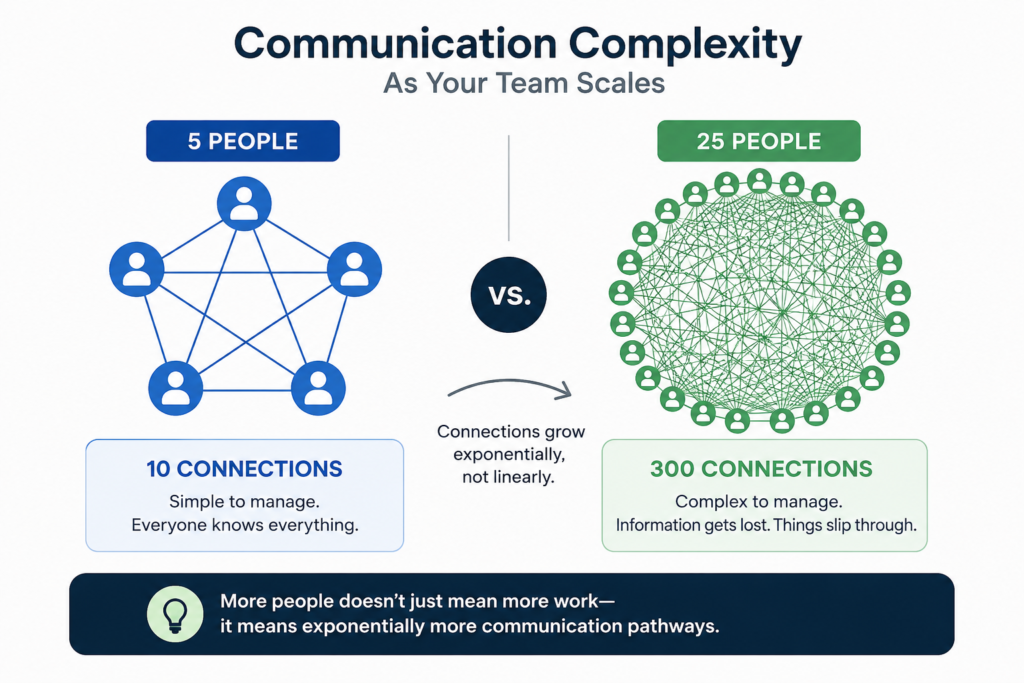
Scaling a business increases communication complexity exponentially. As teams grow from 5 to 25 people, communication pathways jump from 10 to 300, creating operational bottlenecks, information gaps and coordination challenges without scalable systems in place.
Growing teams create exponentially more communication pathways, making coordination harder and increasing operational confusion across departments.
What Actually Breaks (And When)
The 15-25 employee threshold is where operational debt becomes crisis:
- Sales promises what delivery can’t execute because there’s no single source of truth
- Quality depends on which team member handles it, no documented standards exist
- The founder becomes the bottleneck for 47 different decision types
- New hires take 3 months to become productive because tribal knowledge isn’t transferable
This isn’t a people problem. It’s an architecture problem.
The Decision Matrix: Your First Scalable System
Before your next hire, build this:
Level 1 Decisions (Team Lead Authority)
Client delivery changes under ₹10K, standard hiring for defined roles, weekly priority shifts within approved OKRs.
Level 2 Decisions (Founder Approval Required)
New service offerings, contracts above ₹5 lakhs, team structure changes, vendor agreements over ₹1 lakh/month.
Level 3 Decisions (Board/Advisory)
Key pivots, major funding decisions, leadership hires and market expansion.
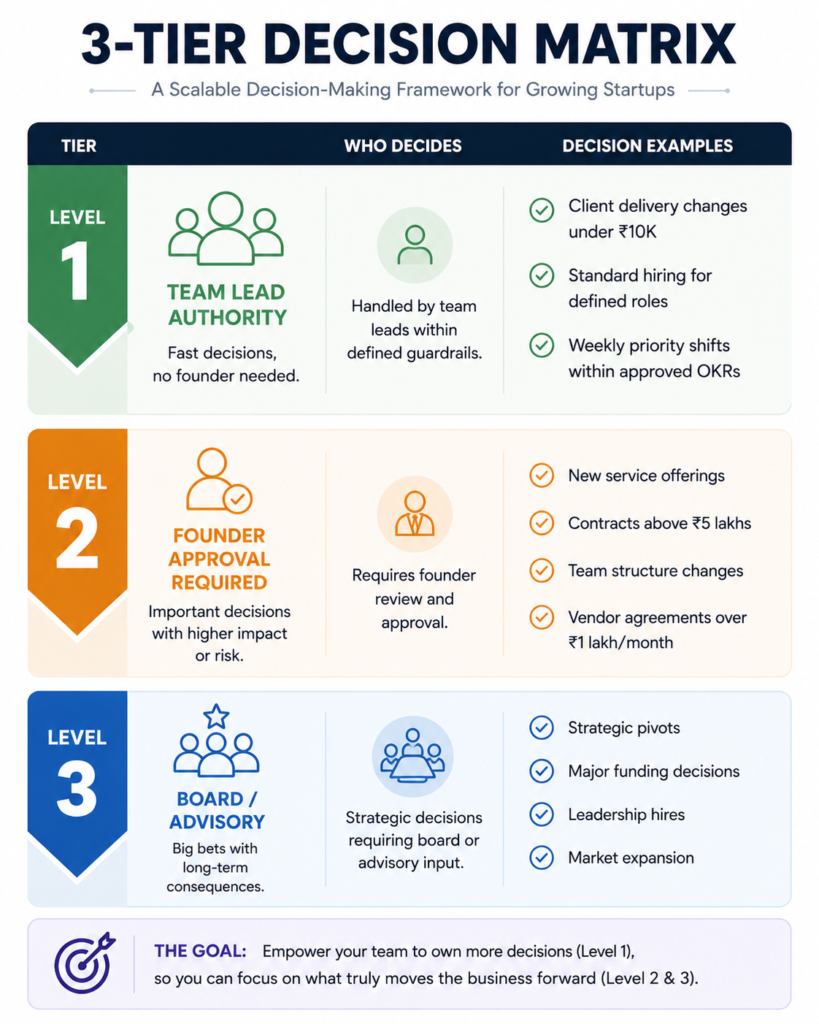
A 3-tier decision matrix helps scaling businesses reduce founder bottlenecks by separating operational, managerial and strategic decisions across team leads, founders and advisory leadership.
The framework provides a separation of operational, managerial and strategic decisions, thus minimizing founder dependency and enhancing organizational scalability.
Document this in Notion. Share it in onboarding. Reference it when someone asks, “Should I check with you first?”
The result: 70% of decisions happen without you. Your team moves faster. You focus on the 30% that actually need founder judgment.
The 90-Day Test
A truly scalable business passes this test: Can your highest-revenue client receive excellent service if you’re unreachable for two weeks?
If the answer is no, you don’t have scaling problems, you have a single point of failure wearing a founder’s badge.
Build the boring infrastructure now:
- Document your top 5 recurring processes (client onboarding, quality standards, escalation protocols)
- Define “good output” for each role in writing, not in your head
- Establish decision processes that enable leaders to take accountability for the results, not just the task
- Establish communication rhythms, weekly stand-ups replace constant Slack firefighting

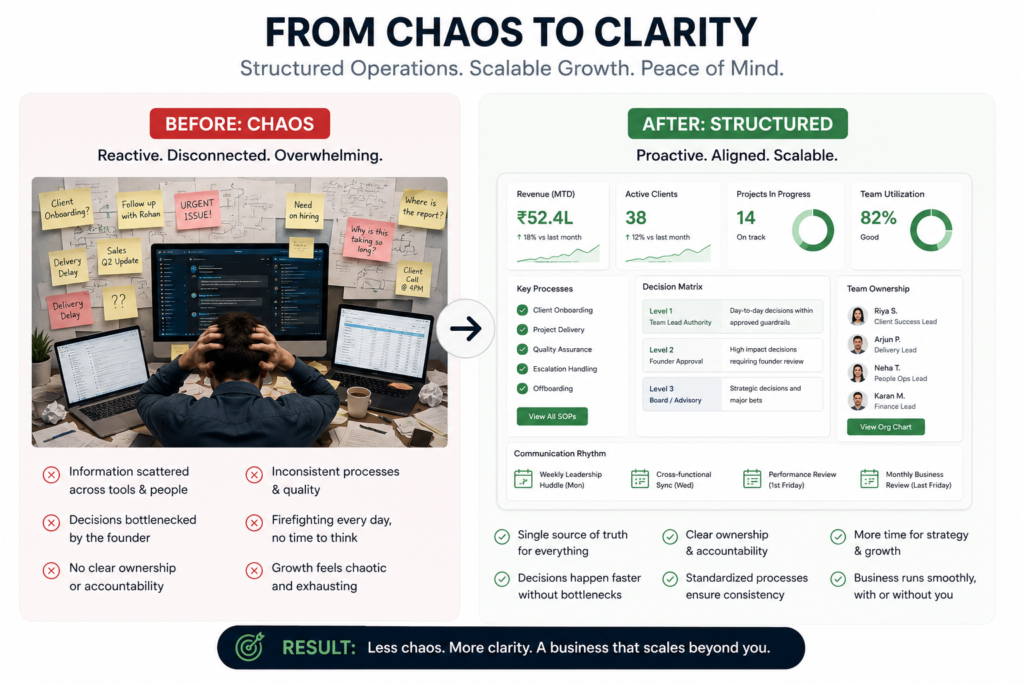
Scaling a business successfully requires moving from reactive chaos to structured operations with clear ownership, documented processes, faster decision-making and scalable systems that reduce founder dependency.
Structured growth systems, defined ownership and standardized processes transform chaotic business operations into scalable, organized growth.
The Uncomfortable Truth
Scaling a business isn’t about working harder. It’s about becoming less essential.
The founder who successfully scales builds systems that work without them, develops leaders who make quality decisions independently and creates clarity that eliminates the need for their constant presence.
That transition feels like a loss of control. It’s actually the only path to leverage.
Most founders wait until chaos forces their hand. The smart ones build structure while they still have the breathing room to think clearly.
Your next 90 days determine whether you’re building a business that scales or a job that traps you. Paaras Panndya helps founders design scalable operations, not firefight chaos.