Let me tell you something I’ve watched happen inside boardrooms more times than I can count.
A promising start-up raises its Series A. Energy is high. The founder, flush with new capital and a sudden urge to look “enterprise-ready,” posts a job listing for a Chief Marketing Officer. Six-figure salary. Equity. The full package.
Three months later, they hire someone impressive on paper. And twelve months after that, quietly, that CMO is gone – and so is a significant chunk of the runway they were supposed to protect.
I’ve seen this play out at companies big and small. And almost every time, the problem wasn’t the person. It was the decision to hire a full-time CMO in the first place.
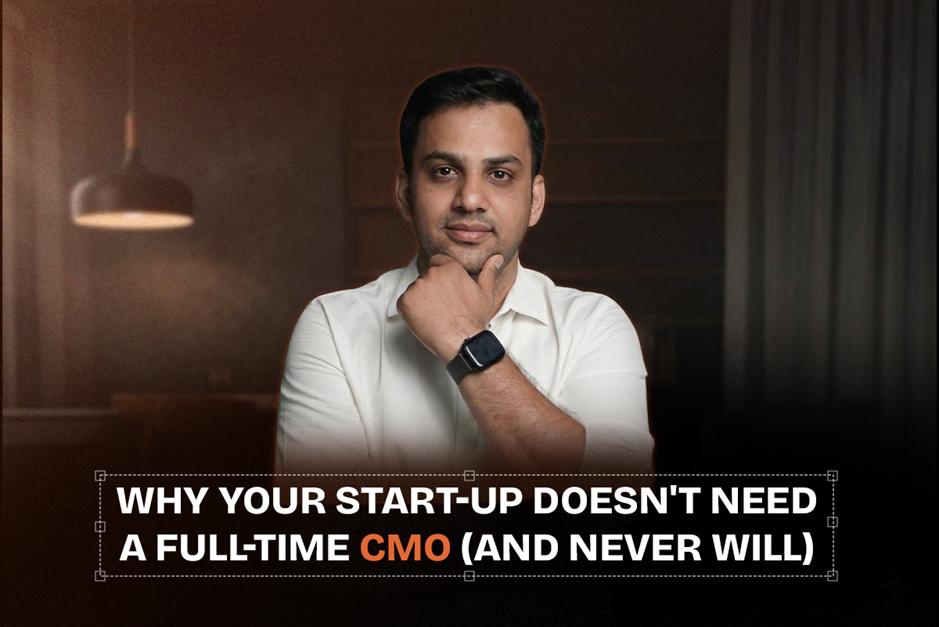
Here’s the truth nobody tells you at the beginning: a start-up doesn’t need a full-time CMO. It needs full-time marketing results.
Those are two very different things.
The Real Cost Nobody Calculates
A full-time CMO at a mid-sized start-up will cost you anywhere from ₹50 lakh to ₹1.2 crore annually when you factor in salary, benefits, equity and the time it takes to onboard them. Add six to nine months before they’ve actually understood your business, your market and your customers. Add another few months of “strategy development” before you see any results.
You’ve just spent the better part of two years and a significant portion of your budget on marketing leadership that may or may not fit where your company actually is right now.
Most start-ups don’t have a leadership problem. They have an execution problem. What they need isn’t someone to build a department, they need someone to build a pipeline.
What Actually Changes When You Go Fractional
A fractional CMO brings you the same level of strategic expertise – sometimes more, because they’ve operated across ten different industries instead of just one – at 20 to 30 percent of the cost. They plug in fast. They’ve seen your exact problem before. They know which strategies work at your stage and, more importantly, which ones will waste your time.
But here’s what most people miss: fractional marketing leadership also forces a discipline that full-time hires rarely bring. When you’re paying for results instead of presence, every decision gets sharper. Every campaign has a clear objective. There’s no comfort of a monthly salary blurring the line between effort and outcome.
Gartner predicts that by 2027, nearly 30% of companies will rely on fractional executives. That number is not a trend. That’s a structural shift in how smart businesses think about leadership.
The Stage Problem
There is a time for a full-time CMO. That time is when your go-to-market is proven, your product-market fit is locked, your team is scaling past 50 people and you need someone embedded in the culture every single day.
Before that? You need strategy, speed and flexibility – not another desk to fill.
The biggest marketing mistake start-ups make isn’t underinvesting in marketing. It’s overinvesting in the wrong kind of marketing structure at the wrong moment.
One Last Thing
In 17 years of working with some of the largest companies in the world, here’s what I know for certain: the businesses that win aren’t always the ones with the biggest teams. They’re the ones that matched the right resources to the right moment.
A fractional CMO isn’t a compromise. For most start-ups, it’s the smartest marketing decision you’ll ever make.