Search is no longer what it used to be. For decades, ranking on Google’s first page was the ultimate goal for any business with an online presence. But in 2025, that aim has changed radically. Today, the real battel is your business cited by ai instead of ranking
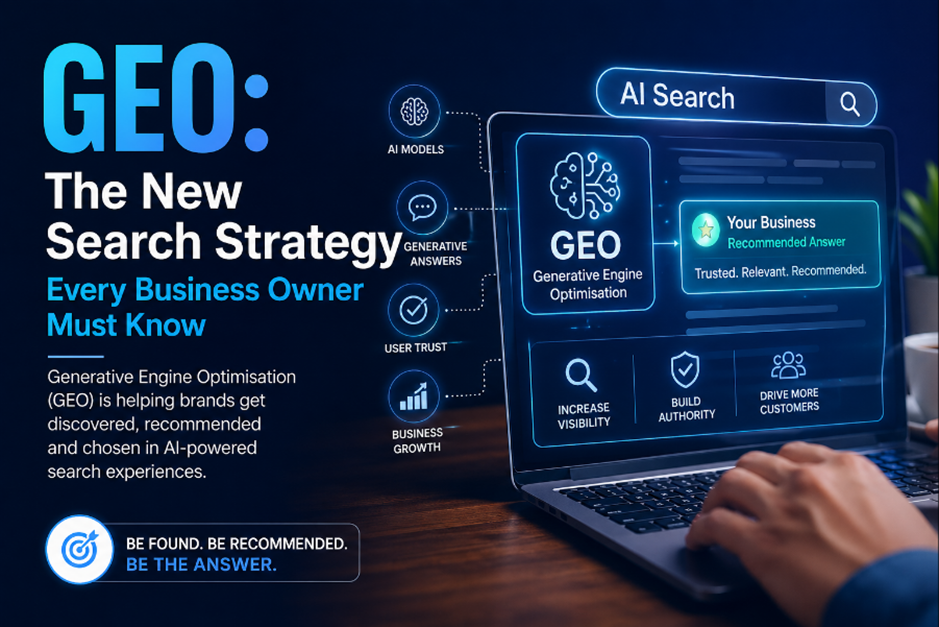
Welcome to the era of Generative Engine Optimisation (GEO).
What Is GEO and Why Does It Matter?
When your customers ask a question to Google’s AI Overviews, Perplexity or SearchGPT, an AI engine reads hundreds of pages, extracts the most trustworthy information and delivers a single summarised answer with citations. They no longer scroll through ten blue links.
If your business is not one of those citations, you are invisible.
GEO is the discipline of structuring your content so that AI engines select, trust and recommend your brand over your competitors. For business owners, this is not a technical luxury – it is a survival strategy.
The Core Shift: From Keywords to Knowledge Chunks
Traditional SEO optimised for algorithms that matched keywords. GEO optimises for AI models that evaluate authority, clarity, and trustworthiness.
AI engines are looking for “knowledge chunks” – a self-contained, accurate and directly useful pieces of information they can safely extract and present to users. If your site hides its expertise and knowledge in lengthy or unorganized paragraphs, AI will ignore it and refer a competitor who answered in the better and clear way.
The practical implication: every major page on your website should open with a direct, concise answer to the question it addresses – within the first 50 words.
Three GEO Priorities for Business Owners
- Build brand mention velocity
Research indicates that brand mentions across authoritative third-party platforms correlate three times more strongly with AI visibility than traditional backlinks. Contributing to industry publications, podcasts and forums is no longer optional – it directly determines whether AI trusts your brand enough to recommend it. - Create structured and decision-support content
AI engines heavily favour comparison pages, FAQ sections and structured tables. If a potential customer asks an AI to compare your service against a competitor, having a well-structured comparison page on your own site increases the likelihood that AI uses your framing to answer that question. - Maintain content freshness
AI models prioritise recency. A page that was authoritative six months ago but has not been updated will lose its AI citations to newer, refreshed content. Scheduling bi-weekly updates to your top-performing pages, including a visible “Last Updated” date – signals to AI crawlers that your information is current and reliable.
The Bottom Line
GEO is not a replacement for good business strategy – it is an amplifier of it. Businesses that communicate their expertise clearly, maintain a consistent presence across the web and keep their content current will earn the trust of AI engines the same way they earn the trust of human customers: by being genuinely useful, credible and easy to understand.
The businesses that adapt to this shift now will not just survive the AI search revolution. They will lead it.