
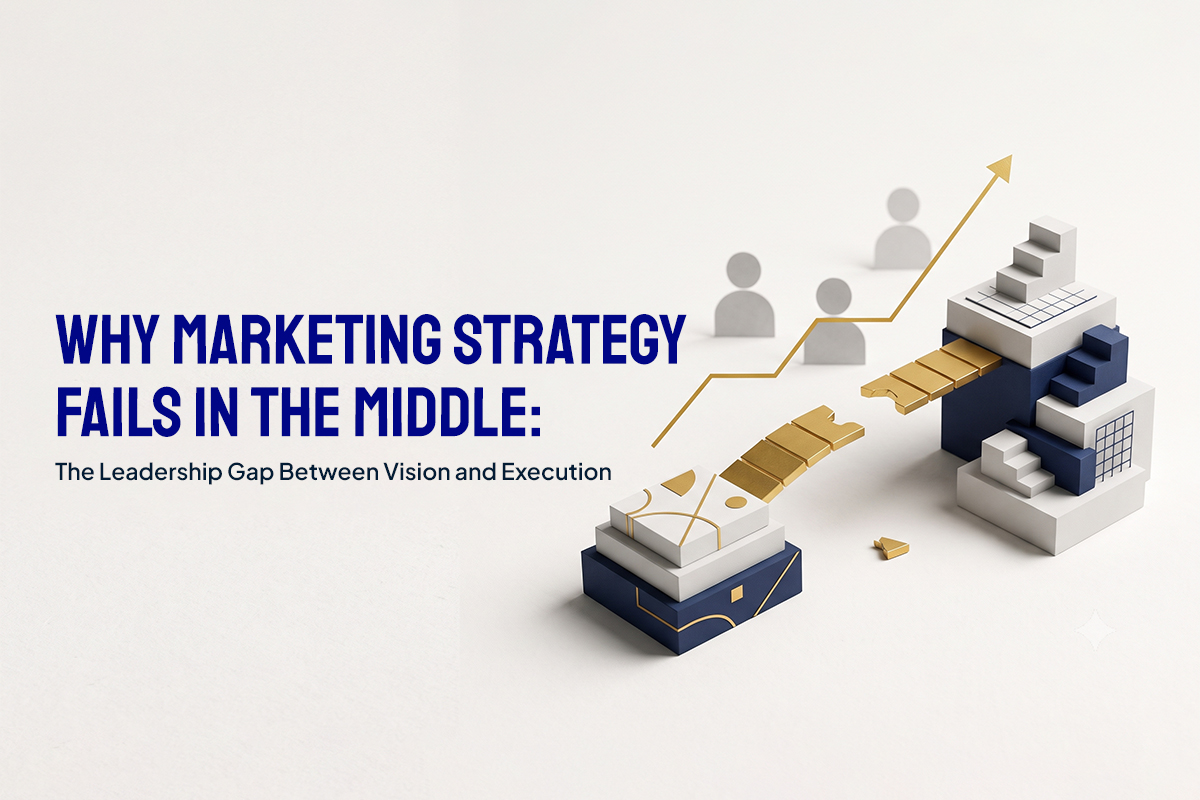
tl;dr: Your plan probably is not the problem. In most companies I work with, marketing strategy execution breaks down in the middle because no senior person sits between the founder’s goals and the team’s to-do list.
Here is how it usually goes. A founder spends December on next year’s plan and walks into January feeling good about it.
Come April, the team’s posting daily and reports arrive on time, yet the numbers look like last year’s. Nobody fought the plan. It just got pushed aside, week by week, by whatever felt urgent.
I’ve had this conversation a lot. This post helps you work out whether it’s a strategy problem or a leadership one. I’ll also explain why more marketing consultant services won’t fix it on its own.
Where Things Actually Break
A Harvard Business Review study I often quote surveyed 7,600 managers across 262 companies and found 55% of middle managers couldn’t name even one of their company’s top five priorities.
Leaders thought they had been clear. The message just never reached the people doing the work.
In a new client’s team meeting I usually see this:
- Everything is “urgent” so nothing gets finished
- Small decisions sit in the founder’s inbox
- Agency briefs talk posts and reels, not results
- Nobody can link this week’s tasks to the annual plan
Most execution gaps aren’t a talent issue (founders hate hearing this). They come down to one thing: no senior person is making trade-offs every week and owning them.
Is It the Strategy or the Execution?
Before paying for a brand new plan, check this.
| Signal | Strategy problem | Execution problem |
| Goals | Vague or conflicting | Clear on paper |
| Team behaviour | Busy without direction | Busy on the wrong things |
| Results | Wrong audience or offer | Right idea, patchy rollout |
| Usual fix | Rework positioning | Add leadership and rhythm |
Most founders I meet are sure the plan is broken. Nine times out of ten it’s fine. Nobody’s actually running it.
A decent marketing strategy consultant should tell you this upfront, even if it means a smaller invoice for them. I’ve said this to plenty of clients myself. It’s never a comfortable conversation to have but it usually saves them a few lakhs in the long run.
Do You Really Need a Full-Time CMO?
The knee-jerk reaction is to go and hire a full-time CMO. Sometimes that’s right, especially once you’ve crossed a certain size. But if you cannot yet say clearly what that person would own, you’re making an expensive bet. Good CMOs don’t exactly show up in a fortnight either.
So what’s the fractional CMO meaning in plain terms? It’s a senior marketing leader working with you part-time (maybe two or three days a month) but accountable for results like an in-house exec.
They don’t send a deck and vanish. They sit in leadership calls, decide what gets dropped, handle agencies and run a weekly team check-in.
If you’ve got 18 minutes, Simon Sinek’s TEDx talk on how great leaders inspire action is worth a watch. He argues people buy into the “why” more than the “what”. In my experience that’s exactly what goes missing in the middle.
What Good Leadership Looks Like Day to Day
When fractional CMO leadership works, it looks pretty boring from outside:
- Three priorities a quarter, max (I once saw a list of eleven)
- The annual plan split into visible weekly commitments
- Managers making calls without escalating everything
- Numbers reviewed monthly, without the direction changing monthly
Nobody writes LinkedIn posts about this stuff. But it keeps a plan alive past week six, when most quietly die.
Conclusion
Plans rarely fail because the idea was bad. They fail between the strategy meeting and the weekly to-do list, where nobody senior is watching.
Fix that gap before rewriting anything. It’s why I work with clients through a 6-month programme rather than an open-ended retainer. Everyone gets a clear finish line. If your plan’s stalled, book a consultation on paraspandya.com.
Frequently asked questions
Why do well planned marketing strategies fail once a team starts executing them?
Nobody owns the step from plan to weekly action, so the plan slowly turns into busywork.
What is the real difference between a marketing strategy problem and a marketing execution problem?
A strategy problem means the wrong audience or message. An execution problem means the plan’s right but delivery is patchy.
When is it advisable to seek external marketing leadership rather than create an internal position for this role?
If there is a need for higher level guidance but you cannot justify a full salary at this point.
What are the red flags that indicate your team has a problem with leadership rather than a skills shortage?
Your team is working hard but not producing anything and priorities continue to change.
How does the cost of a fractional CMO compare to hiring a full-time CMO?
You pay only for the time you use. One US agency puts typical retainers at $5,000 to $10,000 a month, well below a full-time package.