Every company says it has a strategy.
Slide decks get approved. Meetings happen. Brand guidelines are polished. Teams discuss positioning for weeks. Agencies prepare moodboards that look beautiful in presentations.
Then execution begins. And suddenly the strategy starts collapsing in slow motion.
The messaging becomes inconsistent. Sales teams communicate something completely different. Ads promise experiences the product team cannot deliver. Marketing campaigns get changed midway because leadership becomes impatient after two weeks of low numbers.
What looked intelligent inside conference rooms starts looking disconnected in the real market.
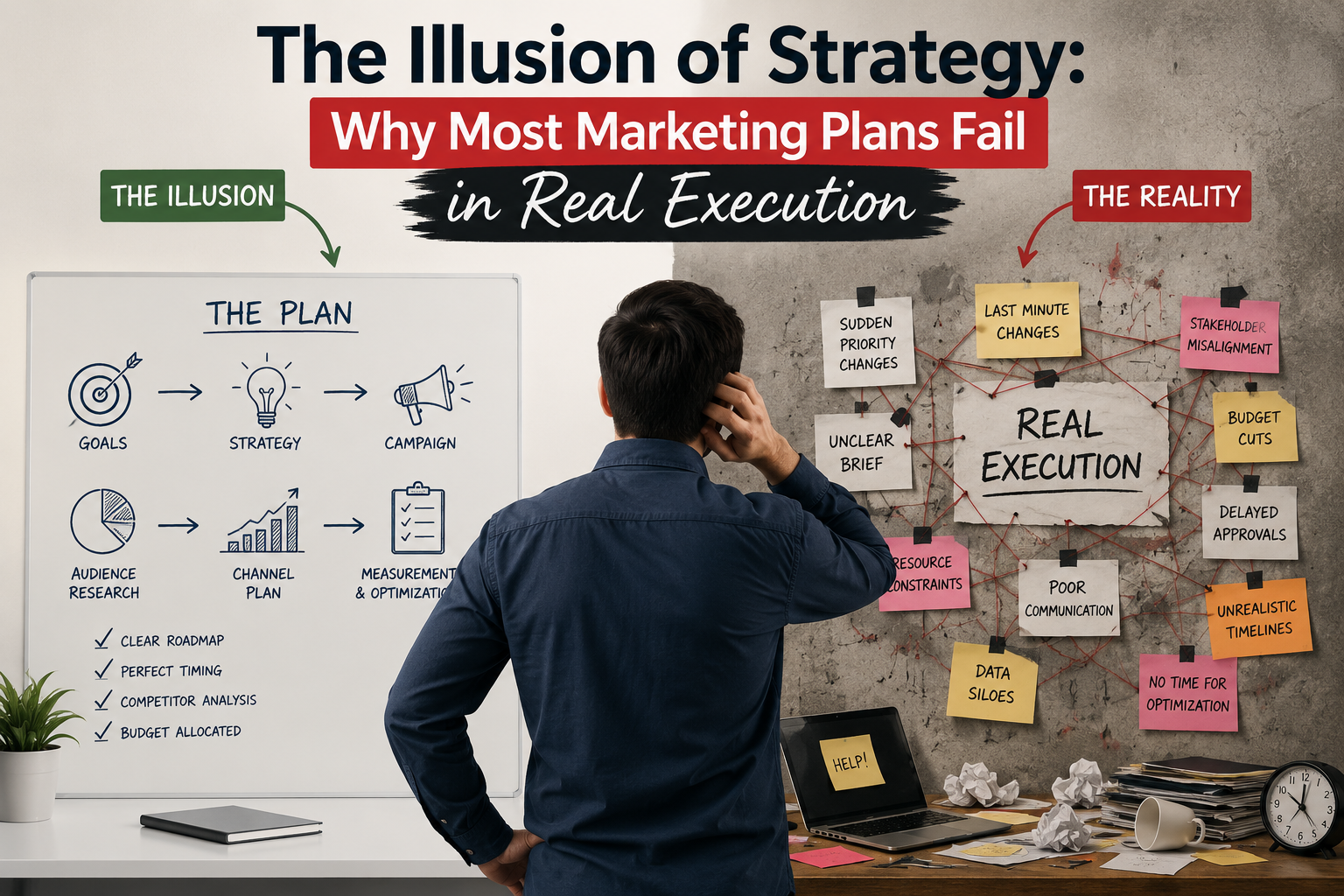
This is the strategy illusion. The belief that creating a marketing plan automatically means the business knows how to execute it.
In reality, most marketing plans fail not because the ideas are bad but because execution lives in a completely different world from strategy.
That gap is where most businesses quietly lose momentum.
The Real Problem Is Not Creativity
A lot of people think marketing fails because brands are not creative enough.
That is rarely the actual issue.
Most businesses already have decent ideas. They know their audience. They know what they want to say. Some even hire expensive agencies to build sophisticated strategies.
But strategy without operational alignment becomes intellectual entertainment.
A brand can spend months refining a premium positioning strategy while the sales team continues offering discounts every week.
A company can talk about “customer experience” while customer support takes four days to reply.
A founder can approve a modern content strategy while demanding approval for every Instagram caption.
This is why marketing plan execution problems happen so often.
The market does not judge the strategy document. The market judges what people actually experience.
And customers notice inconsistency faster than marketers think.
Most Marketing Plans Are Built in Isolation
One of the biggest reasons why marketing plans fail is because strategy is often created far away from execution reality.
Leadership teams create vision decks. Marketing teams translate those ideas into campaigns.
Agencies convert them into creatives. Sales teams reinterpret the messaging during customer conversations. By the time the idea reaches the customer, it barely resembles the original strategy.
Every layer change something. This is called strategic dilution. And it quietly destroys brands. A luxury brand suddenly sounds discount driven.
A premium SaaS company starts posting generic motivational content. A D2C skincare brand begins copying trends that have nothing to do with its positioning.
The strategy becomes fragmented because too many people are interpreting it differently. Most businesses do not have a strategy problem. They have a translation problem.
Marketing Strategy vs Marketing Plan Difference
A lot of businesses confuse strategy with planning. They are not the same thing.
A marketing strategy is the core direction.
It answers:
- What are we trying to become?
- What perception do we want in the market?
- Why should customers trust us?
- What competitive position are we building?
A marketing plan is execution.
It includes:
- channels
- timelines
- campaigns
- budgets
- content schedules
- performance metrics
The problem is that companies spend too much time polishing the plan and very little time stress-testing the execution.
A spreadsheet is not proof of market readiness.
Just because a campaign looks organized does not mean the business can sustain it operationally.
That difference matters more than most businesses realize.
The Hidden Reason Execution Breaks
Most marketers underestimate operational friction.
Good marketing creates expectations.
Operations must fulfill them. If marketing promises fast delivery but logistics fail, then trust collapses. If content promises expertise but sales conversations feel weak then authority disappears.
If a brand pushes emotional storytelling but customer experience feels transactional then the audience notices the disconnect immediately.
Execution fails because businesses treat marketing like communication instead of infrastructure.
Real marketing is operational.
It requires alignment between:
- leadership
- sales
- support
- product
- design
- delivery
- customer experience
Without alignment even brilliant strategies fail.
This is where many startups struggle.
They chase branding before building operational consistency.
The Obsession with Constant Reinvention
Modern marketing teams panic too quickly.
One campaign underperforms for ten days and suddenly everything changes.
New messaging, new audience, new positioning and new strategy.
Most brands never stay consistent long enough to build recognition. Good marketing often looks repetitive internally before it becomes memorable externally.
People inside the company get bored with the message long before the audience even notices it.
So, businesses keep reshuffling campaigns instead of optimizing what already shows traction.
That reactive behavior kills momentum. The smartest brands usually do the opposite.
They repeat winning patterns aggressively, they refine instead of restarting and they understand that consistency compounds.
Why Frontline Teams Matter More Than Strategy Decks
Many companies create strategies without involving the people who actually speak to customers every day.
That is a huge mistake
- Sales teams understand objections.
- Customer support teams understand frustration points.
- Delivery teams understand operational gaps.
- Frontline employees see reality much earlier than leadership presentations do.
But in many businesses, they are excluded from strategic conversations entirely.
Then leadership wonders why execution feels disconnected.
If the people representing the brand do not understand the positioning deeply then customers will never feel it consistently.
Real strategy must travel beyond boardrooms.
It must become visible in conversations, support interactions, onboarding experiences and customer trust.
That is where brands are actually built.
The 3-3-3 Rule Most Businesses Ignore
Complexity is one of the biggest silent killers in marketing execution.
Businesses try to communicate too many things at once.
Too many audiences.
Too many promises.
Too many channels.
That creates confusion internally and externally.
Simple strategies survive execution better.
One practical framework is the 3-3-3 rule:
- 3 core messages
- 3 audience segments
- 3 primary marketing channels
That forces clarity.
When teams understand exactly what matters execution becomes easier to maintain.
The strongest brands are usually simple enough to repeat consistently.
Framework for Actionable Strategy
Most marketing plans fail because they stay theoretical.
Execution needs structure.
A simple framework looks like this:
[business objective] ➔ [1-2 core levers] ➔ [weekly sprints] ➔ [daily tracking]
That creates operational focus.
Instead of chasing endless ideas teams work around measurable momentum.
Execution improves when strategy becomes actionable at the daily level.
The Real Future of Marketing
The internet has made strategy look glamorous.
Everyone talks about branding psychology, storytelling frameworks and growth systems. But execution still decides survival.
The companies winning today are not always the most creative. Often, they are simply the most aligned.
Their teams understand the same message. Their operations support the promise. Their content reflects actual customer reality.
Their positioning stays consistent long enough to build trust. That discipline matters more than trendy marketing language.
Even marketers like Paaras Panndya often emphasize that modern branding is less about making noise and more about maintaining strategic consistency across every touchpoint.
Because customers do not experience your strategy document.
They experience the execution.
Final Thoughts
The strategy illusion happens when businesses mistake planning for progress. Beautiful presentations create confidence. Execution creates results.
That difference changes everything. A real marketing strategy is not proven inside meetings.
It is proven when customers repeatedly experience the same trust, message and positioning across every interaction with the brand.