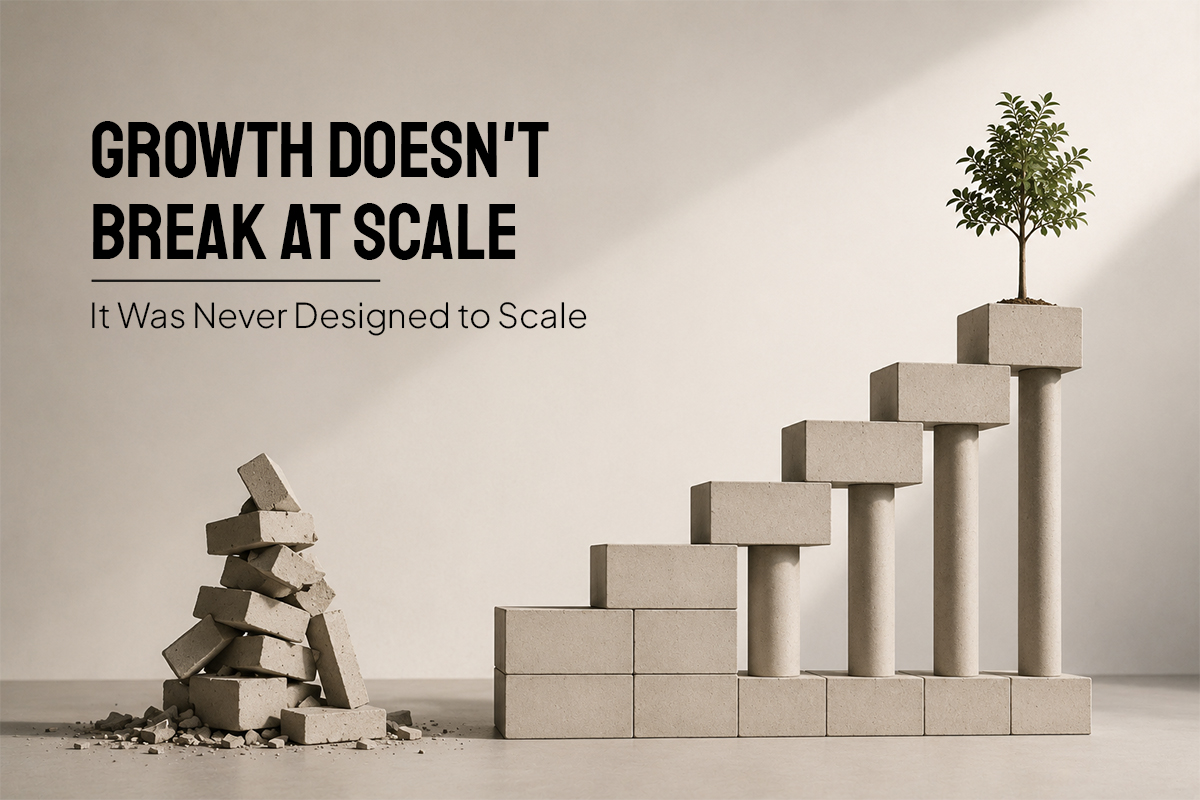
Growth doesn’t expose bad luck. It exposes bad architecture.
You scaled from ₹20 lakhs to ₹2 crores in ARR. Hired 15 people. Tripled ad spends. And suddenly, everything that worked before… stopped working.
CAC climbed 40%. Customer complaints doubled. Your team became a bottleneck instead of a multiplier. Decision-making that took hours now takes days.
This isn’t a growth problem. It’s a design problem you’ve been ignoring since day one.
Early Growth Rewards Speed, Not Stability
Here’s what most founders miss: early success masks structural debt.
When you’re at ₹10 lakhs monthly revenue, the founder can personally close every deal, review every deliverable and fix every customer issue. This feels like “high-touch excellence.” It’s non-transferable dependency.
Your first 20 customers forgive manual processes. Your next 200 won’t. What you built was a founder-operated system optimized for 10 clients, not a scalable business model designed for 100.
The symptoms appear predictable:
- Revenue grows, but margins compress
- Hiring accelerates, but execution slows
- You add channels, but CAC rises
- Team expands, but everything still routes through you
This is the scaling paradox: what got you here becomes what traps you there.
Scale Doesn’t Create Chaos, It Reveals It
Most founders blame scale for breaking their businesses. Scale didn’t break anything. It simply amplified existing fragility.
The 5 Signals Your Growth Model Isn’t Scalable
- Revenue depends on <5 people
If three key employees leave, does your business survive? If not, you don’t have a system-you have talented mercenaries. - CAC rises aggressively with spend
Doubling ad budget doesn’t double customers, it erodes unit economics. You found product-market fit for one channel at one scale. That’s not scalability. - Support volume scales faster than revenue
Every new customer creates exponentially more firefighting. You’ve automated acquisition but not success. - Execution velocity drops as headcount grows
More people should mean faster output. You’re increasing the number of meetings and delaying decisions, not increasing your ability. - The decision-making process
Instead of saying, “Here’s what I did,” you say “What should I do?” to your team. No, you’re not leading; you’re micromanaging at a massive level.
If three or more apply, your growth engine isn’t ready to scale. According to a Harvard Business Review study, operational bottlenecks, rather than market conditions, are the number one culprit in 78% of high-growth start-ups failing to sustainably scale up.
Fast Growth Is Temporary. Scalable Growth Is Systemic
The difference isn’t semantic – it’s structural:
| Fast Growth | Scalable Growth |
| Founder-dependent execution | Process-dependent systems |
| Manual workflows | Automated operations |
| Channel concentration | Diversified acquisition loops |
| Reactive hiring | Role clarity before headcount |
| Centralized decisions | Distributed ownership |
| Heroic firefighting | Preventive infrastructure |
Fast growth companies celebrate hockey-stick revenue. Scalable growth companies build compounding operational leverage.
You can have fast growth that collapses in 18 months. Or scalable growth that compounds for years. The businesses that survive choose architecture over adrenaline.
The Infrastructure Required Before Your Next Hire
Scaling requires systems before traffic. Here’s what must exist before you accelerate:
Scalable Customer Acquisition
Not just “Facebook ads work” but documented playbooks: audience targeting frameworks, creative testing systems, attribution models that survive iOS updates, diversified channel mix (not 80% dependent on one platform).
Scalable Operations
Can your delivery process handle 3x volume without founder involvement? If it lives in someone’s head, it’s a single point of failure. Document SOPs. Define quality standards. Build checklists that outlast tenure.
Scalable Team Structures
Engage people to own rather than perform tasks. KPIs, decision-making authority and success indicators should be well-defined for each role. Avoid dependency: If you are hiring “somebody to do some marketing”, you are creating dependency not capability.
Scalable Data & Reporting
Real-time visibility and reporting on unit economics, CAC by channel, LTV cohorts, churn drivers, and conversion bottlenecks. Your founder will be flying blind if they are unable to access numbers within 60 seconds.
Scalable Retention Systems
Acquisition without retention is a leaky bucket at scale. Create automated onboarding flows, health score tracking, expansion playbooks, success milestone tracking. It’s more economical to keep revenue than to get it.
A 90-day roadmap to building a Scale-Ready Growth Engine
Most businesses are mistakenly equating activity with scalability. Fewer ads, fewer hires, fewer tools. It is not architecture, it’s amplification.
The order they work is as follows:
Month 1: Eliminate Founder Bottlenecks
Write down all your choices for 14 days. Categorize them. 70% should be delegable with clear frameworks. Build decision matrices. Train team leads. Start saying “What would you do?” instead of “Here’s what to do.”
Month 2: Standardize Core Processes
The top 5 workflows that you repeat in your business (sales, delivery, support, onboarding, hiring) should be documented, measured and improvable by people who are external to the business. Without a checklist, you cannot get a consistent output, it’s not a process, it’s folklore.
Month 3: Build Repeatable Acquisition Loops
Identify your one reliable channel. Reverse-engineer it. What makes it work? Can it scale? What’s the marginal CAC curve? Then, systematically test two more channels. Diversification isn’t optional, it’s survival.
Within 90 days, your business should pass this test: Can you take a two-week vacation without revenue, delivery, or operations degrading? If yes, you’ve built scalability. If no, you’ve built a job that employs you.
The Uncomfortable Truth About Scaling
Scaling inefficiency only amplifies inefficiency. Adding budget to broken funnels burns capital faster. Hiring into unclear roles creates organizational bloat. Expanding channels before nailing retention kills CAC/LTV ratios.
The companies that scale successfully do something counterintuitive: they slow down to speed up. They fix the foundation before adding floors.
This feels unnatural. Your competitors are announcing new funding, new hires, new markets. Resist the FOMO. Sustainable business growth isn’t about who grows fastest, it’s about who’s still growing in year five.
Your growth didn’t break. The system was always fragile. You just finally hit the load limit.
Ready to build infrastructure that survives scale?
– Paaras Panndya, Growth & Operations Strategist
Frequently Asked Questions
What is scalable growth?
Scalable growth means building systems that multiply output without proportional cost increases. It’s designing operations where doubling revenue doesn’t require doubling headcount or spend.
Why do businesses struggle to scale?
Because early growth rewards speed over structure. Manual processes, founder dependency and channel concentration work at small scale but break at volume- creating operational bottlenecks and rising costs.
How to create scalable systems?
Document core processes, remove founder bottlenecks, diversify acquisition channels, enable data visibility, invest in retention infrastructure and define ownership of roles before growing with pace.
What causes CAC to rise during scaling?
Channel saturation (exhausting your best audience), operational inefficiency (broken funnels), retention failure (requiring constant acquisition and lack of diversification (over-dependence on one channel).