Most founders, when growth slows, reach for the same diagnosis: more leads, better ads, a new funnel. It’s the obvious lever. It’s also almost always wrong. In Paaras Panndya’s experience working with growth-stage businesses across India, the real problem is rarely outside the company, it’s inside it.
The businesses I’ve watched stall at ₹2 crore, ₹5 crore, ₹20 crore they rarely stalled because demand dried up. They stalled because the machinery of deciding, approving and acting had quietly seized. The pipeline was full. The team was busy. The numbers looked decent. But underneath it, decisions were piling up like invoices no one was clearing.
That’s the thing about decision latency. It’s invisible until it isn’t.
When the Company Stops Running and Starts Waiting
There’s a particular moment in a founder’s journey that nobody warns them about. You’ve crossed the early chaos the scrappy, figure-it-out phase and now you have a team. Systems are being built. You’re delegating. On paper, the business is maturing.
But somewhere between ten and forty people, something shifts. The team stops moving autonomously. Not because they’re incompetent. Because every meaningful action a proposal, a pricing call, a campaign change, a vendor contract routes back to the founder for approval.
Decision latency sets in. And it compounds.
A sales proposal waits three days for sign-off. A client deliverable sits in review for a week. A hire gets delayed because the founder hasn’t found time to interview. The marketing team won’t launch a campaign without explicit green light. Meanwhile, inbound is healthy, the brand is growing and from the outside everything looks fine.
Inside, execution has slowed to a crawl.
The Approval Stack Is a Revenue Problem
Founders tend to treat approvals as a management issue. They’re not. They’re a revenue issue.
Every decision that waits has a cost, often invisible, always real. A proposal that takes five days to leave your desk is five days your competitor could have moved first. A campaign delayed by internal alignment meetings means your Q2 budget burns in Q3. A hiring decision postponed for two months means your existing team operates understaffed for two months.
Multiply that across an organization of thirty people, each hitting three or four decision gates per week and you get an extraordinary amount of wasted execution capacity. The team isn’t idle. They’re waiting. They’re following up. They’re hedging. They’re working around the bottleneck rather than through it.
This is what I call execution drag and it has nothing to do with traffic, reach or demand.
The Founder as Critical Path
Here’s the uncomfortable truth most operators don’t say out loud: in many growth-stage businesses, the founder is the most dangerous node in the entire system. Not because they’re making wrong decisions, but because everything is routed through them and they are, by definition, the scarcest resource in the company.
When the founder is the critical path, every team’s velocity is capped by one person’s availability. Sales can’t close without them. Marketing can’t commit without them. Operations can’t adapt without them. The business is, structurally, a single point of failure wearing the clothing of an organization.
This is not a leadership problem in the motivational sense. It’s an architecture problem.
Most companies don’t redesign this until something breaks visibly, a key hire leaves out of frustration, a client churns because delivery slipped, a revenue quarter comes in soft despite strong demand. The decision bottleneck rarely announces itself. It just quietly degrades every other metric.
Decision Flow as Organizational Infrastructure
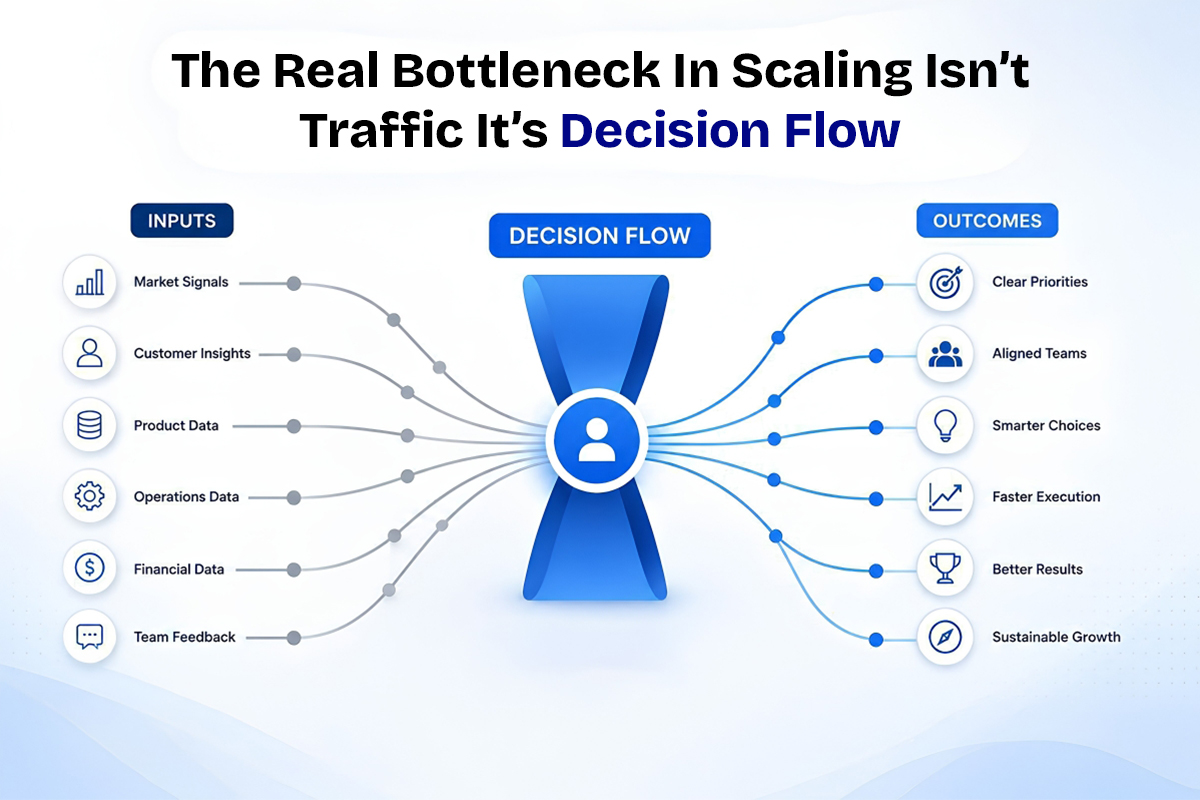
What high-functioning scaling companies build and what most early-stage companies skip, is decision infrastructure. Not culture. Not values. Not mission statements. The actual mechanisms that allow decisions to be made correctly, quickly and without founder involvement.
This means several concrete things.
First, every recurring decision needs a written default. Not a discussion. A default. How do we price custom scopes? What’s our policy on discounts? At what deal size do we escalate? When defaults exist, teams execute without routing upward. When they don’t, every edge case becomes a conversation.
Second, trust must be explicitly extended, not assumed. Founders often believe they’ve delegated authority. Their teams often believe they haven’t. This gap between perceived delegation and felt permission, is where most execution drag lives. People don’t move because they’re not certain they’re allowed to. The fix isn’t motivation, it’s clarity.
Third, the cost of a wrong decision made fast is almost always lower than the cost of a right decision made slowly. This is counterintuitive for founders who built their business on precise judgment. But at scale, speed of iteration matters more than perfection of individual choices. A campaign that launches imperfectly and gets refined outperforms a campaign that gets approved two months late.
The Metric Nobody Tracks
Most companies track pipeline, revenue, CAC, churn, NPS. Almost none track decision cycle time how long it takes from identifying a decision to executing on it.
That number, if you measured it honestly, would explain more about your growth ceiling than any marketing metric.
When decision cycle time is days, the company moves fluidly. When it stretches to weeks, departments start working around each other. When it hits months, the business loses its ability to respond to market shifts, to client feedback, to competitive pressure. The company becomes reactive to external events rather than directive in its own growth.
What This Actually Looks Like to Fix
The companies that successfully navigate this don’t hire a COO and call it done, though sometimes that helps. They redesign how authority flows through the organization.
They document decision rights explicitly, who can decide what, at what threshold, without escalation. They create communication channels designed for fast alignment, not for covering tracks. They train team leads to own outcomes rather than manage tasks. They stop rewarding founders who remain indispensable and start building systems that make indispensability structurally impossible.
Most importantly, they treat organizational clarity as a growth lever, not a soft operational concern but a hard commercial one.
Because here is what’s actually true: your growth ceiling isn’t set by how many people you can reach. It’s set by how fast you can act on what you already know.
Traffic is a visibility problem. Decision flow is a survival problem.
One can be bought. The other has to be built.