Almost every founder who calls me opens with some version of “our marketing isn’t working.” Usually the marketing is fine. What is broken is the thinking under it. When there is no real brand positioning strategy behind the business, each new campaign turns into a debate from scratch. People end up fighting over headlines because nobody ever agreed on the promise.
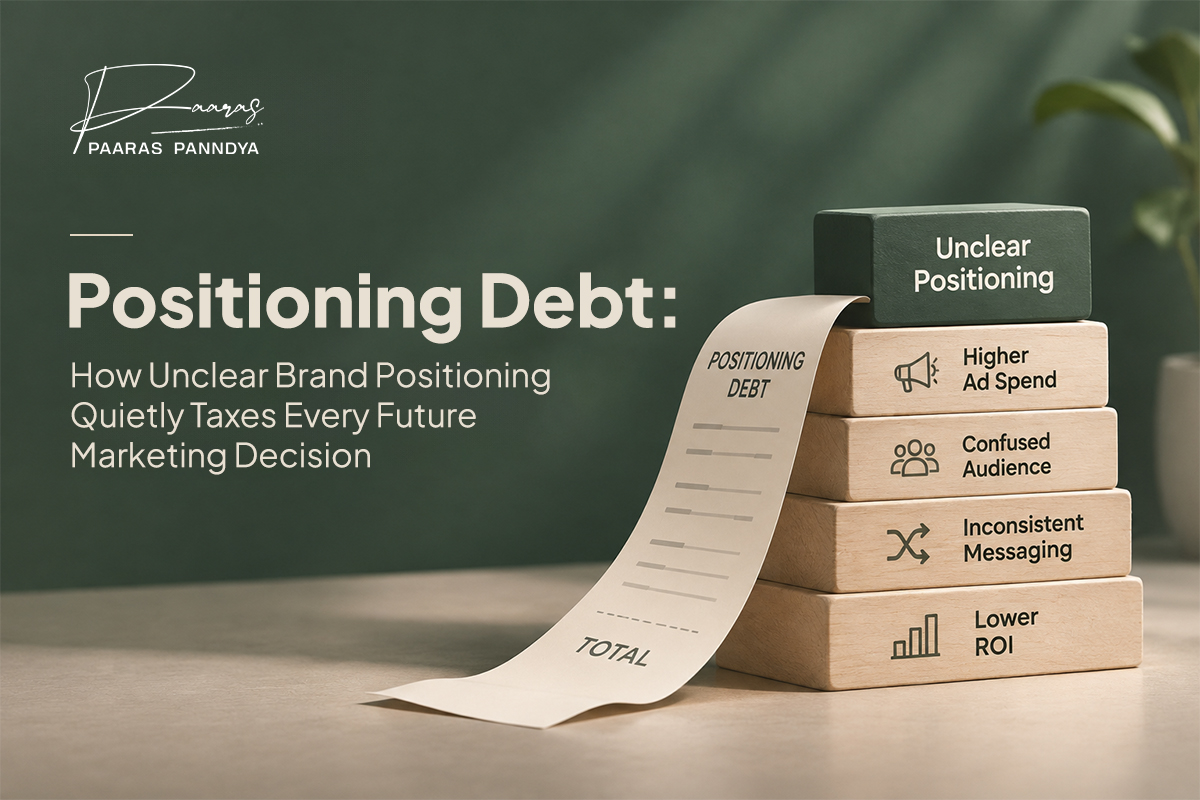
I started calling this positioning debt a few years ago, borrowing the idea from software teams who talk about technical debt. You don’t feel it in month one. By year three it’s sitting on top of every decision you make.
What Positioning Debt Actually Looks Like
Put simply, it’s the distance between what you think your business stands for and what customers actually believe about it. Every fuzzy call widens that gap a little.
I usually see it creep in like this:
- In the early years you take any client who’ll pay, which is fair enough when payroll is due.
- Three different people write the website over five years and none of them talk to each other.
- Sales pitches one version of the company. The ads say something else. The founder says a third thing on podcasts.
- New services get bolted on because one client asked, not because they fit.
No single one of these feels like a mistake when it happens. Put them together though and you get dozens of small, unclear marketing decisions that leave the business unable to describe itself in one sentence.
The Interest You Pay Without Noticing
Honestly, the bad campaign is the smaller cost. The bigger one is all the time burned before anything goes live.
I once watched a leadership team spend most of an afternoon on one landing page headline. Nobody in that room was bad at their job. They just couldn’t agree on who the page was for, so every opinion carried the same weight.
That afternoon was interest on positioning debt. Most companies pay it every week in rewrites and long agency briefs. Since it never shows up as a line item, nobody is ever asked to fix it.
Why Weak Brand Positioning Makes Every Marketing Decision Harder
Clear brand positioning acts like a filter. It gives your team permission to say no. Take it away and every idea has to be defended from scratch, so whoever talks loudest tends to win.
The research lines up with what I see in client rooms. Marq’s State of Brand Consistency research found 85% of organisations have brand guidelines, yet only about 30% enforce them consistently. Around 77% say they deal with off-brand content.
Most organisations have brand guidelines, but only 30% enforce them
Share of organisations surveyed (%)
| Have brand guidelines | 85% | |
| Consistently enforce them | 30% | |
| Deal with off-brand content | 77% |
This should come as no shock. Generally, the guidelines have the positioning of the logo and the blue colour used. It is highly unlikely that a company will specify how the business will make the consumer feel. One cannot maintain consistency with the messaging without having the definition right from the start. I’ve seen brand books that have gone well past forty pages without answering the one simple question the customer is asking themselves.
Brand Foundation vs Surface-Level Branding
Most businesses spend on the visible stuff first. Logo, colours, a decent website. I get why, because it feels like progress. But all of it sits on a brand foundation that in a lot of companies was never really poured.
When I check whether that foundation exists, I ask four questions:
- Who is our best-fit customer? And who are we happy to lose?
- When we are not in the room, what do buyers compare us against?
- What can we do that those alternatives honestly can’t?
- What proof do we have?
If the answers change depending on which person in the team you ask, there’s a crack in the foundation. Anything built on top of it will wobble.
Here is roughly how that crack shows up across a business:
| Business area | With clear positioning | With positioning debt |
|---|---|---|
| Pricing | Priced on value, fewer discount requests | Compared on price, constant discounting |
| Paid ads | Tight targeting, messages that convert | Broad targeting, rising cost per lead |
| Content | One clear point of view | Generic posts that sound like competitors |
| Sales | Short, confident pitch | Long calls explaining “what we actually do” |
| Hiring | Candidates self-select in | More misfit hires and slow onboarding |
| Agency work | Briefs that fit on one page | Endless revisions and agency churn |
How Positioning Debt Taxes Pricing, Ads and Hiring
Founders tend to underestimate this bit. A fuzzy brand positioning strategy doesn’t stop at a weak tagline. It leaks into parts of the business that seem to have nothing to do with marketing.
Pricing. If a buyer can’t see why you are different, price becomes the only thing left to compare. Clarity is what lets you charge more. Consumers in PwC’s customer experience research said they’d pay up to a 16% premium for a good experience. That’s what people said rather than what they paid, so I treat it as a signal.
Ads. Ad platforms reward relevance. A message written for everybody gets ignored by most of them. You end up paying for clicks that go nowhere.
Hiring. Good people want to understand what they are joining. A vague company tends to attract the curious rather than the committed.
Over my 17+ year growth strategy experience, hiring has been the cost founders spot last. It turns up as the sales hire who keeps chasing the wrong customer. Or the marketer who “repositions” the brand every quarter because nobody gave them a clear position to begin with.
A strong brand can cut cost per hire by up to 50% in LinkedIn data
Reported upper-end effects. Different studies and measures.
| Lower cost per hire | 50% | |
| Revenue lift | 33% | |
| Lower employee turnover | 28% | |
| Price premium | 16% |
These figures come from separate studies, so I wouldn’t read them as a forecast. The lesson that I learn from them is that clearness usually pays off in multiple places. Once the customers know what you do, then the recruiting process becomes easier. People tend to stick around. You can defend your prices better once the negotiation becomes difficult or once customers demand a discount.
Market Positioning Strategy: When Founder-Based Businesses Fail
Market positioning strategy determines your competition and where you compete. It’s easy to miss by the founder-based businesses since all knowledge about the company remains within the mind of the founder. While the founder is involved in all sales meetings, everything remains under control. It quietly stops once the team grows.
Common Mistakes That Are Made Again and Again
- Trying to appeal to everyone. It feels safe. In practice it’s the most expensive option on the table.
- Copying the category leader. Sound like the leader and buyers will just go with the leader.
- Leading with features. People pay for outcomes. Features only prove you can deliver them.
- Never revisiting it. Markets move. Something that worked five years ago can slowly turn into debt.
Some of the best brand positioning examples are almost boring in how focused they are. Volvo has talked about safety for decades. IKEA keeps coming back to affordable furniture you put together yourself. Neither tries to win on every attribute, which is exactly why they are easy to remember.
Paying Down the Debt: A Practical Positioning Strategy in Marketing
You don’t need a six-month rebrand to get started. What you need is a handful of decisions written down and then defended whenever someone wants to drift.
This is roughly the order I work through with clients:
- List your real competitive alternatives. Include “do nothing” and “hire someone in-house.” In my experience those two lose you more deals than any named competitor.
- Find what only you can claim. Look for things the alternatives genuinely can’t do.
- Name the customer who values it most. Be specific about size, stage and what triggers the purchase.
- Pick the market frame. Decide which category you want to be judged in.
- Write it in plain words. One page. If it needs jargon, it isn’t finished.
A good positioning strategy in marketing should make your next ten choices easier. If it can’t help you settle a campaign, a price or a hire, it’s still too vague.
If you’d rather watch than read, this step-by-step positioning walkthrough on YouTube covers a similar framework in under ten minutes. I’d share it with the team before your first positioning workshop.
When to Bring in Outside Help
Some founders can do this on their own. Plenty can’t. This is completely normal. Having spent enough time inside an organization, you lose that outside perspective that your customers have on things.
Of course, it helps if you have an external point of view that’s skeptical about whatever discussion your group might be having. The right brand strategy consultant will never give you the perfect deck and walk out of the picture. They’ll ensure that your team makes some tough trade-offs, validates them through customer discussion and sticks around until the position is taken. And after the discussion is over, it becomes much simpler. For most leadership teams that alone frees up hours each week.
Final Thoughts
Positioning debt hardly ever arrives as a crisis. It shows up as friction. One more meeting, one more rewrite, one more discount. The upside is that it can be paid down, starting with a few clear choices you are willing to protect.
I’m Paras Pandya. I’ve seen businesses unlock growth they already had the capacity for, just because a clear brand positioning strategy finally gave every team the same answer to “who are we for?” So if your marketing feels busier than it should, the problem may not be the marketing at all.
Frequently Asked Questions
What does unclear brand positioning actually cost a business over time?
Mostly time and margin. Decisions slow down, acquisition costs creep up, pricing power weakens and work gets redone. Those costs pile up quietly over the years. A company without a strong positioning strategy for its brand will keep having to pay the price for it again and again.
Which are the most frequent brand positioning errors made by founder-led businesses?
These are trying to serve everyone, mimicking the dominant company in the category, highlighting features over results and not sharing the positioning in the founder’s mind with others.
How do you know your brand positioning is wrong, even though your marketing “seems” right on the surface?
Have five people in your organization describe your ideal customer and your uniqueness to you. If there are five different descriptions, you’ve got the message. There are other signs like giving discounts too often, having sales calls that last forever, and writing copy that looks like your competitors’.
What is the difference between a positioning statement for a brand and brand positioning strategy?
The former is one or two sentences that represent your position. The latter is the entire brand positioning strategy which comprises the rationale behind it including alternative competitive offerings, targeted market segment, supporting evidence and demonstration of the positioning in terms of pricing, sales and content. You can think of the former as an output and latter as the strategy itself.
In what ways does poor positioning subtly influence pricing, advertising effectiveness and staffing, in addition to messaging?
Poor positioning encourages customers to compare prices. It also forces broad ad targeting, which costs more. On top of that, it attracts candidates who never fully understand what the company stands for.