tl;dr: Each of my clients/start-up founders can tell you the one act that got the business going. A sharp offer. A founder who closed every deal. A channel that suddenly worked. The uncomfortable truth is that the same move often becomes the thing holding the company back. The awkward reality is that it’s the very same move that can stifle the company. Business growth strategy have a shelf life and most business leader realize it has expired by the time its revenues slow.
What is the scaling paradox?
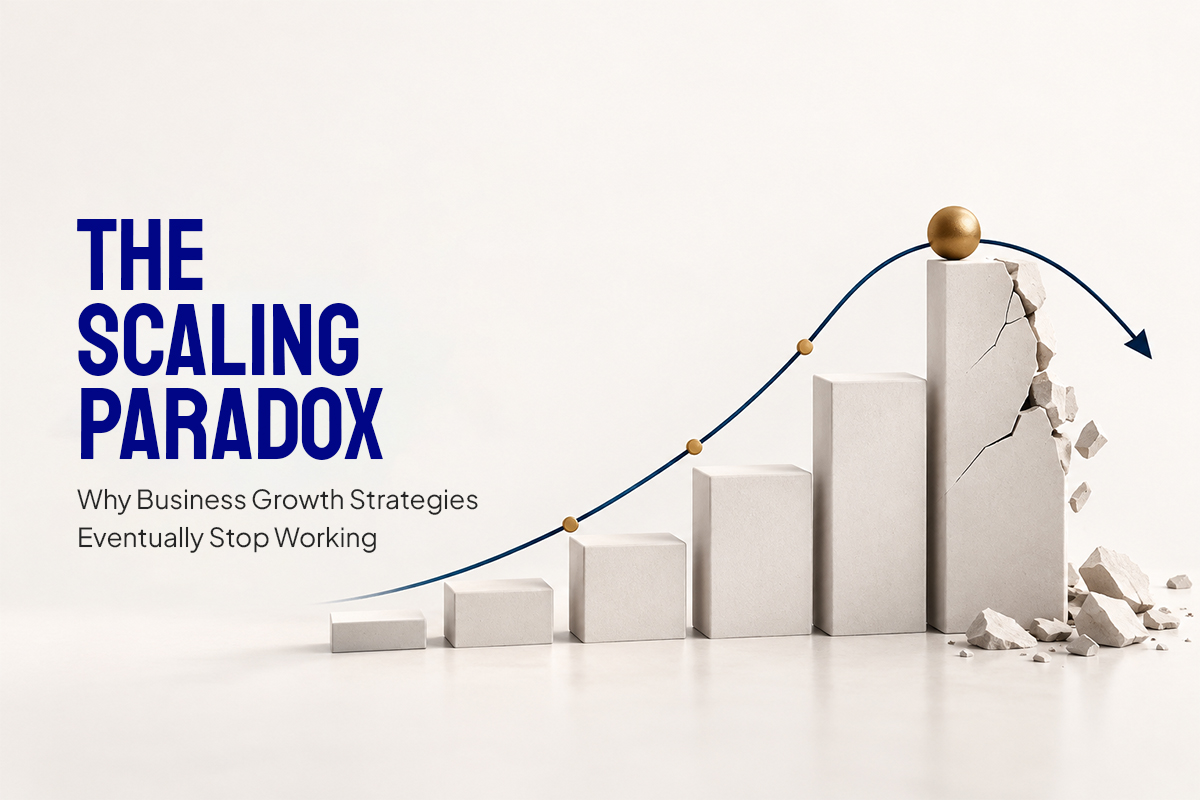
The scaling paradox is the situation where the tactics that work at a smaller size fail in the larger size. Forbes Councils member Melissa Sierra makes a similar point in her article on why growth obsession is breaking your foundation. Her argument is that scale should come from strong foundations and never replace them.
I have learned that it’s not about adding revenue, it’s about scaling a business. Revenue is an outcome. Real scale means revenue rises while cost and complexity stay under control.
Early Warning Signs You Have Outgrown Your Strategy
Watch for these signals:
- Every decision still waits for the founder
- Revenue grows while margin shrinks
- Strong hires leave within a year
- Delivery quality slips as customer numbers rise
- Meetings multiply while output stays flat
The more than two, the more likely you are to have a key growth problem in the business than a demand issue.
What Is Execution Debt?
Execution debt builds when a team skips process, documentation and ownership to move fast. Like financial debt it works well for a while. Then the interest arrives as rework, missed handoffs and tired people. Any sound business development strategy must include a clear plan for repaying outstanding debt.
Why Early Wins Become Later Blockers
Each early tactic is a loan against the future:
- Founder-led sales build dependency on one person
- Heavy discounting trains buyers to wait for the next offer
- Fast hiring dilutes culture and clarity
- Manual workflows break under higher volume
Fix Systems or Strategy First?
Fix the foundation first. A scalable growth system rests on three layers:
- Clarity: define who you serve and what you will stop doing
- Systems: document the work that repeats every week
- Decision rights: decide who owns which call
Sierra suggests a simplified approach before scaling and development of decision systems with simple principles. I agree. Written principles and clear authority is better than a founder who approves everything to make better scaling business decisions.
Create a Growth Plan that can scale
A business growth plan that is practical is short and is reviewed quarterly. Use this sequence:
- Audit where time and money leak
- Name the single biggest constraint
- Set one metric that proves the constraint is easing
- Assign one owner
- Review and repeat
Don’t try to change five things at one time. One constraint is removed well before 5 is fixed halfway.
Marketing and Expansion Under Pressure
As audiences become saturated with growth marketing strategies like paid ads or outbound, they lose their effectiveness. If your cost to acquire a customer only continues to increase, the channel issues are by no means your only problem. The sales process or the offer itself may no longer be the right one for the market that you are in today.
Expansion adds more strain. Before entering a new city or product line your business expansion strategy should answer one question. Can the current operation absorb this without breaking?
choose one on founder bottlenecks or scaling systems
Conclusion
The most scalable companies are not the ones most obsessed with scaling. They are the ones who are so caught up about clarity and ability. If your growth feels chaotic right now the answer is rarely more effort. At Paras Pandya we offer strategic growth consulting that finds the real constraint first and then builds the systems to remove it.
Frequently Asked Questions
What makes the strategies that brought a business to success not work as the business expands?
Tactics are dependent on size. A volume & complexity problem can prevent a founder-driven approach from working with 100 customers.
What are the initial indicators of a business expansion that has become too large?
The most prevalent symptoms are slow decision-making, declining margins, increasing employee turnover and quality decline. Revenue may still look healthy while these appear.
What is “execution debt,” and how does it slow down scaling businesses?
It is the hidden cost of skipping the process and ownership to move fast. The cost returns later as rework and delays.
Scaling a business is like growing its revenue?
No. Growth adds revenue. Scaling doesn’t mean adding revenue but also without increasing cost or chaos.
When growth starts feeling chaotic, should a founder fix the strategy first or the systems first?
Confidence in strategy is the key point to begin with, since systems designed with an unclear strategy will only compound the confusion. Then build systems to support it.